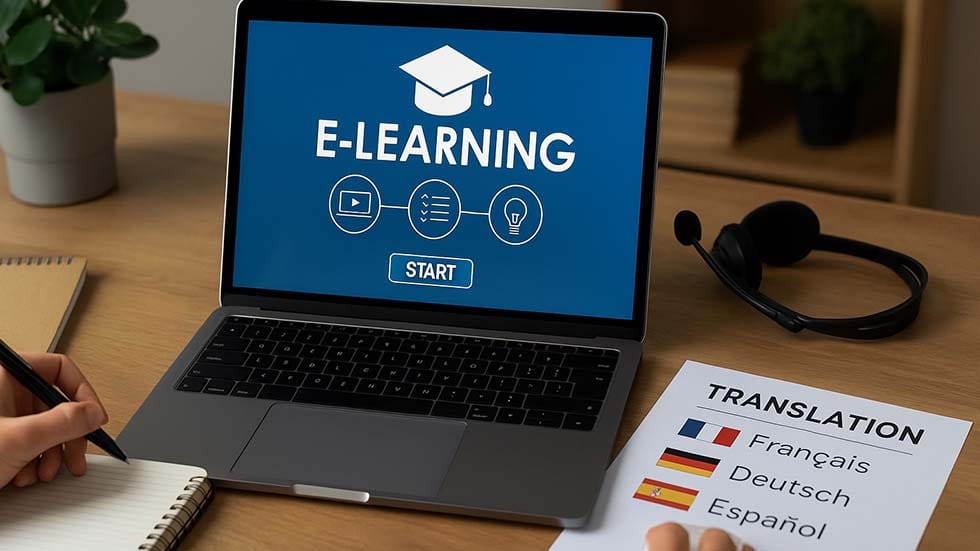
Digital education is no longer the future – it is the present. E-learning platforms and online courses enable global access to knowledge, but only if they are adapted to the language and culture of the end user. In this context, high-quality translation doesn’t just mean transferring words – it means adapting content, tone, and structure for different markets. Here’s what drives the success of e-learning content today and what clients need when looking to globalize their courses.
Localization is key – not just translation
Translation alone is not enough for e-learning. Learning is deeply tied to cultural context, so localization involves:
- Adapting examples, terms, and visuals
- Using an educational tone that resonates with the target audience
- Translating video subtitles, voice narration, and interactive elements
- Aligning content with pedagogical standards in different countries
If the content doesn’t “speak the language” of the learner – in every sense – engagement and retention will drop.
Most commonly translated formats
The most in-demand materials for translation and localization include:
- Video lessons and their subtitles (subtitles and captions)
- Narration scripts and voice-over content
- PDF documents, manuals, and slide presentations
- Interactive quizzes and assignments
- LMS interface (menus, messages, navigation)
Each of these formats requires a specialized approach and technical processing.
Trends in e-learning localization
The e-education market is becoming increasingly demanding. Some of the key trends include:
- Market-specific personalization – the same course adapted to multiple cultures
- Multilingual support in real time (e.g., synchronized subtitles or AI voice-over)
- Accessibility compliance – translations that meet WCAG standards (screen readers, contrast, etc.)
- Short-form content – ideal for microlearning, requiring fast and accurate localization
Companies are investing more in quality localization as part of their educational growth strategy.
Why translation quality is critical
A poorly translated course not only reduces engagement – it can cause misunderstandings, frustration, or even legal issues (in the case of certified programs). A professional translation ensures:
- Clarity in instructions and explanations
- Consistent terminology across all modules
- Tone and style that match the target audience
- Technical accuracy and readability on all devices
How to choose a translation partner for e-learning content
You’ll get the best results when working with an agency that:
- Has experience with educational projects and LMS platforms
- Offers both linguistic and technical services (subtitling, voice-over, graphics)
- Can scale projects – from a single course to entire platforms
- Understands the intersection of culture, education, and technology
Translation for e-learning is not a technical task – it’s a pedagogical, cultural, and technological adaptation. If you want your course to truly reach a global audience, you need a team that understands how people learn – both in language and in context.
Alfa Prevod offers full e-learning localization services, from script translation to video synchronization.
If you’re planning to internationalize your online course, contact us – we’ll help you make knowledge truly global.
